
Sailing Ventotene & Santo Stefano, Italy
Eastern Pontines rich with history and calm anchorages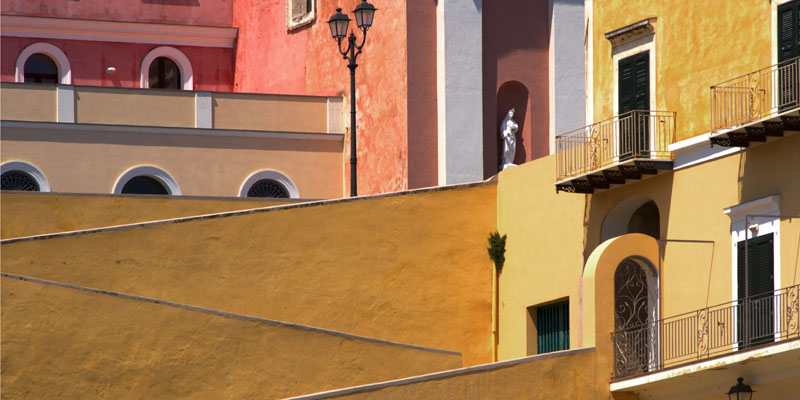
The eastern group of the Pontine Islands is very different from Ponza and Palmarola and includes tiny Ventotene (under 2 km²) and the islet of Santo Stefano. Ventotene’s lower half is the south-eastern flank of a volcanic crater, layered with softer rock above it. Morphologically it is a gently sloping plane dropping from south-west to north-east, much of it planted with vines, lentils, and vegetables.
Few islands pack so much ancient and modern history into such a small patch of land. Legend makes Ventotene the sirens’ island from the Odyssey. Augustus certainly built an imperial villa here with baths and a theatre—still visible today—where he banished his daughter Julia for her “loose morals.” The island later hosted other patrician women and discarded imperial wives, including Agrippina (wife of Tiberius) and Octavia (wife of Nero). Many Christians self-exiled to Ventotene to escape persecution. Because it was harder to reach than Ponza and lacked natural defences against pirates, it became uninhabited until the 18th century, when the Bourbon kings of Naples exiled 30 prostitutes and 30 criminals here, believing nature would “restore morality.” The predictable outcome did not stop colonisation: 20 families from Torre Annunziata and other Amalfi Coast towns were enticed to settle with generous incentives. To this day Ventotene, though part of Lazio, speaks the Neapolitan dialect. In the 20th century it hosted political exiles and prisoners sent by the fascist regime from the 1920s onward.
Harbours and anchorages
Despite lacking the colourful palette of Ponza and Palmarola, the island gives visitors a magnetic charm, a sense of belonging, and inner calm. Two harbour structures serve Ventotene: the old Roman Harbour—hewn entirely from tuff, with ramps, storage rooms, bollards, and fish ponds—still used by boats up to 15 m; and the New Harbour, an artificial extension of Cala Rossano recently enlarged. The island and Santo Stefano are a protected marine reserve.
Departing Porto Nuovo, we round Punta Eolo at the north end. The imperial villa ruins sit above; below, shoals mean you pass wide, beyond the Sconciglie—diving heaven with or without tanks. Next is Cala Parata Grande, sheltered from easterlies and sirocco; a tripline is wise almost everywhere around the island because large boulders can trap anchor and chain. Continuing anticlockwise we meet emerald coves sheltered from easterly winds up to the impressive Punta dell’Arco. Rounding the point puts us on the east side, protected from the maestrale. Almost any spot is good for anchoring with the usual care. Further north-east is Cala Nave with its serviced beach and two islets you can easily swim to—a perfect jumping playground. Beyond lies the Roman Harbour, a feat of engineering and sheltered from all winds.
Diving and the panopticon
Ventotene’s seabed is superb for scuba: several diving centres work from the Roman Harbour, and swimming through schools of barracuda or meeting giant groupers is an everyday event.
The islet of Santo Stefano sits just over half a nautical mile from the Roman Harbour and offers no shelter. It hosts the Bourbon Prison (UNESCO heritage) now under restoration. Designed by Kaspar Van Wittel (Vanvitelli) in the 1700s while he was building the Royal Palace of Caserta and executed by his students, its horseshoe shape is the first panopticon, letting a guard at the centre see into every cell—a harsh fate for prisoners. Here, two political detainees, Altiero Spinelli and Ernesto Rossi, secretly wrote (1940–41) the Manifesto of Ventotene, the social reform document that first launched the idea of a united Europe—realised some 70 years later. The main building of the European Parliament in Brussels is named after Altiero Spinelli.
Plan your training week
- Season: Spring to early autumn for settled weather; Maestrale brings fresher air and clear skies.
- Approach: Respect reserve zones; expect checks from the marine authority, especially near Santo Stefano.
- Moorings: Roman Harbour for small craft (up to ~15 m) and Porto Nuovo for larger boats.