Sailing Ponza, Palmarola & Zannone, Italy
Colour-shifting cliffs, Roman legacy, and wild reserves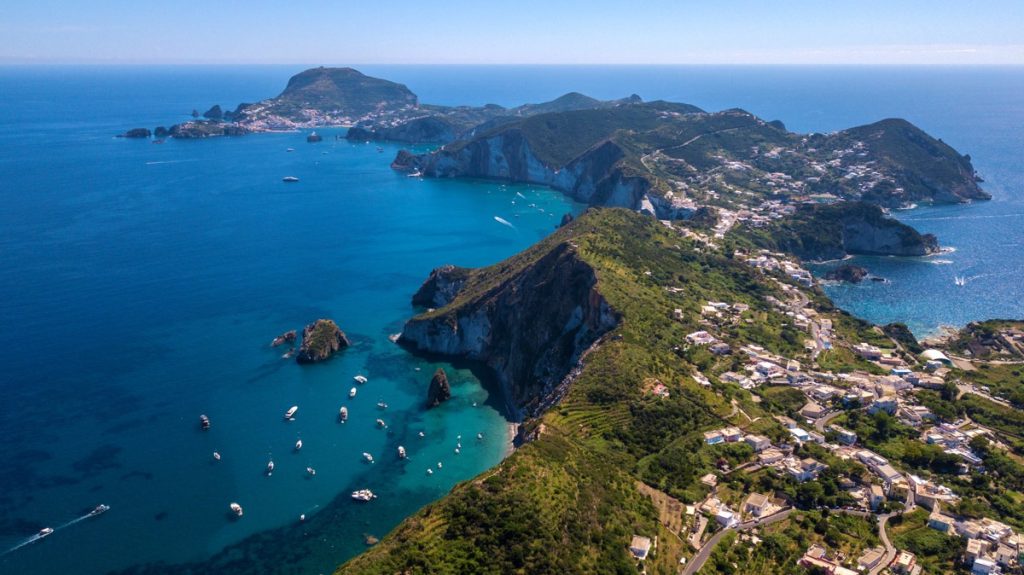
A little history. The Romans used Ponza as a holiday retreat—some patrician women were exiled here, but to a very comfortable exile. During the Punic wars Ponza became a municipium, supplying and defending Rome against the Carthaginian fleet. They carved aqueducts, cisterns, tunnels, and quays into the soft tuff to water the fleet based in Capo Miseno. After pirate raids emptied the islands in the Middle Ages, colonization resumed in the 1700s under the Farnese and Bourbon families. Before tourism, the islands hosted political prisoners. Deodat de Dolomieu marvelled at the mineral variety—cliffs shifting from ochre to red, white, green, and pearl grey—later praised by Jacques Cousteau as one of the world’s ten most beautiful archipelagos.
Ponza may be just under 10 km², yet boasts 25 km of coast. Its crescent shape and countless coves make it naturally “portuosa” (from the Greek Pontos). Highlights on the east side: the roadstead off the main harbour (sheltered S–NW, but busy; exposed to NE/SE squalls), the broad Frontone Bay with sandy holding (exposed to SE/NE), the turquoise Cala del Core and striking Cala Inferno, then the arch of Arco Naturale. Rounding tiny Gavi leads to the west side: Cala delle Felci with emerald water and sulphur veins (shelter from southerlies), the dramatic cliffs down to Cala dell’Acqua (lee from NE–S), and colourful Cala Feola with its fisherman basin, fine sand beach, and natural pools—ideal with easterly winds.
Ponza: southern coast and night glow
Continuing south brings the superb Lucia Rosa bay—turquoise water with a Polynesian feel. Beyond the faraglioni of Lucia Rosa, keep a sharp lookout: shoals lurk both offshore and inshore toward Capo Bianco, riddled with caves in snow-white tuff. Next opens the magnificent Chiaia di Luna under a zabaione-yellow cliff. The beach is closed for rockfall risk but it offers excellent lee from easterlies and ample sand with gradually shoaling depths—safe even for night arrivals. Under moonlight the cliff reflects a soft glow across the bay. Rounding Capo della Guardia (lighthouse) returns you to the east: after the Faraglioni del Calzone Muto you find the turquoise Parata cove and, offshore, the Formiche rocks—great for fishing and diving—before closing the loop back to the main harbour.
Ponza tips: when northerlies pipe up on the east side, move quickly to western anchorages; expect steep chop to build fast. Use reliable electronic charts and a bow watch near Lucia Rosa–Capo Bianco for scattered shoals. A trip ashore rewards you with colourful hilltop houses and supplies above Cala Feola.
Palmarola
Palmarola lies just 3 nm from Lucia Rosa and shares the same geology: towering multicoloured cliffs and winter silence (only a summer restaurant with cave-rooms carved by early settlers). Start at Cala del Porto, dominated by the Faraglione di San Silverio; it is exposed to west swell but unique with easterlies. A steep path leads uphill for sweeping views. At the southern tip rise the Faraglioni di Mezzogiorno with caves best explored by tender; pass between them and the island only by tender (≈1 m depth).
Rounding the cape reveals beautiful Cala Brigantina, once patrolled by a Bourbon brigantine to deter pirates. Sheltered from W/NW/NE, it also gives partial lee from easterlies behind Scoglio Suvace. Keep at least 500 m off the west side for near-surface rocks (Secca Zirri). The east coast gives solid lee from westerlies with turquoise water and spires. At Cala delle Cattedrali (gothic-like cliffs), you can swim into caves; depths drop quickly so pick calm weather. Round Punta Tramontana wide for submerged hazards, then past the Faraglioni delle Galere back to Cala del Porto. Best explored by SUP or tender along the walls.
Zannone
Unlike volcanic Ponza and Palmarola, Zannone is far older—a rare outcrop of the ancient “Tirrenide” continent (with Montecristo, Corsica, Sardinia). It is a rounded hill with no true bays and only workable in settled weather; partial lee from westerlies is possible on the east side.
The island is uninhabited and part of the Circeo National Park. Its lush vegetation escaped the terracing and clearing seen on its neighbours; fish thrive in the quiet waters. Ashore, a trail climbs through holm oak woods to the ruins of a Benedictine monastery and a crest overlooking the island. You also find oaks, fig trees, arbutus, and a small colony of mouflon imported from Sardinia in the 1960s.
Plan your cruise
- Wind shifts: East-side coves on Ponza turn uncomfortable with NE/SE—shift to the west quickly.
- Night safety: Chiaia di Luna offers ample sand and gentle shelving for after-dark arrivals when Levante blows.
- Hazards: Maintain lookout near Lucia Rosa–Capo Bianco and west Palmarola (Secca Zirri); avoid tight inshore tracks.
- Tender time: Palmarola and Ponza’s grottoes reward SUP/tender exploration—plan daylight circuits.